 AUS
AUS
 US
US



TNUoS Tariffs 2026/27: What the new 60%+ increase means for UK businesses
In this blog, Luke Prior, Channel Development Manager at SmartestEnergy, shares that The National Energy System Operator (NESO) has confirmed the 2026/27 TNUoS tariffs, showing one of the largest year‑on‑year increases ever recorded.

The National Energy System Operator (NESO) has confirmed the 2026/27 TNUoS tariffs, showing one of the largest year‑on‑year increases ever recorded.
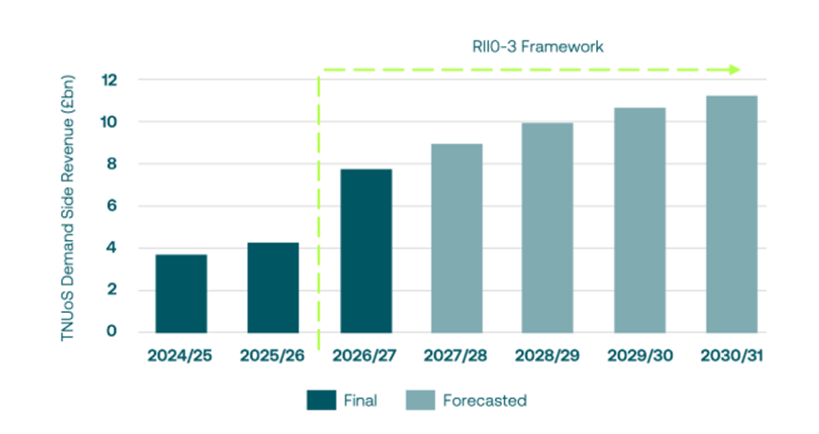
Average charges for businesses will rise by around 60–64% from April 2026.
This uplift reflects the significant grid investment required to support the UK’s transition to a low carbon system. Total TNUoS revenues are projected to rise from £8.9bn in 2026/27 toward £13.6bn by 2030/31, driven largely by the RIIOET3 price control.
While methodology changes under REMA are still pending, the immediate financial impact on energy users is now fixed for the upcoming charging year.
Why costs are rising
- Major reinforcement and expansion of the transmission network to connect growing volumes of renewables.
- Sharp increases in allowed transmission revenue—expected to more than double by early 2030s.
- Higher fixed residual charges, which make up over 90% of TNUoS costs
What this means for corporate
1. Higher bills, even with efficiency measures
As most TNUoS is now recovered through standing charges, businesses will see cost increases regardless of consumption levels.
2. Energy budgets will tighten
Electricity bills are expected to rise 5–10% for many businesses purely due to TNUoS.
Some regions may experience even higher banding increases.
3. Greater value in demand flexibility
Load shifting, revisiting demand profiles, and operational optimisation become more important to reduce exposure where possible.
4. Stronger case for on-site generation
Solar, storage, and other behind the meter solutions can offset rising grid related fixed costs.
5. A growing share of the corporate energy bill
While methodology is unchanged, analysis suggests TNUoS could grow from around 8% today to 15%, and potentially 23% of total bills by 2030/31, aligning with long term revenue growth forecasts.
The confirmed 2026/27 TNUoS tariffs mark a structural shift: higher fixed grid charges, higher long term system investment, and significantly greater cost exposure for corporates. With further reforms due under REMA, this is only the first phase of change.
How can SmartestEnergy help?
With TNUoS now representing a much higher proportion of consumer costs, it’s becoming ever more important for customers to understand how they can contract appropriately. SmartestEnergy have a number of different fixed and flexible supply products that allow users to structure the non-commodity charges in line with their risk strategy which include pass through and setting for preferred durations.
Please get in touch with your SmartestEnergy relationship manager to discus in more detail.