 AUS
AUS
 US
US



PPAs in a changing power market: Navigating risk and unlocking value
The PPA market is becoming more complex, more volatile, and more central to project financing than ever before. Business Development Manager, James Clark, explores the risks, and opportunities shaping the renewable energy sector, following an engaging PPA panel discussion.
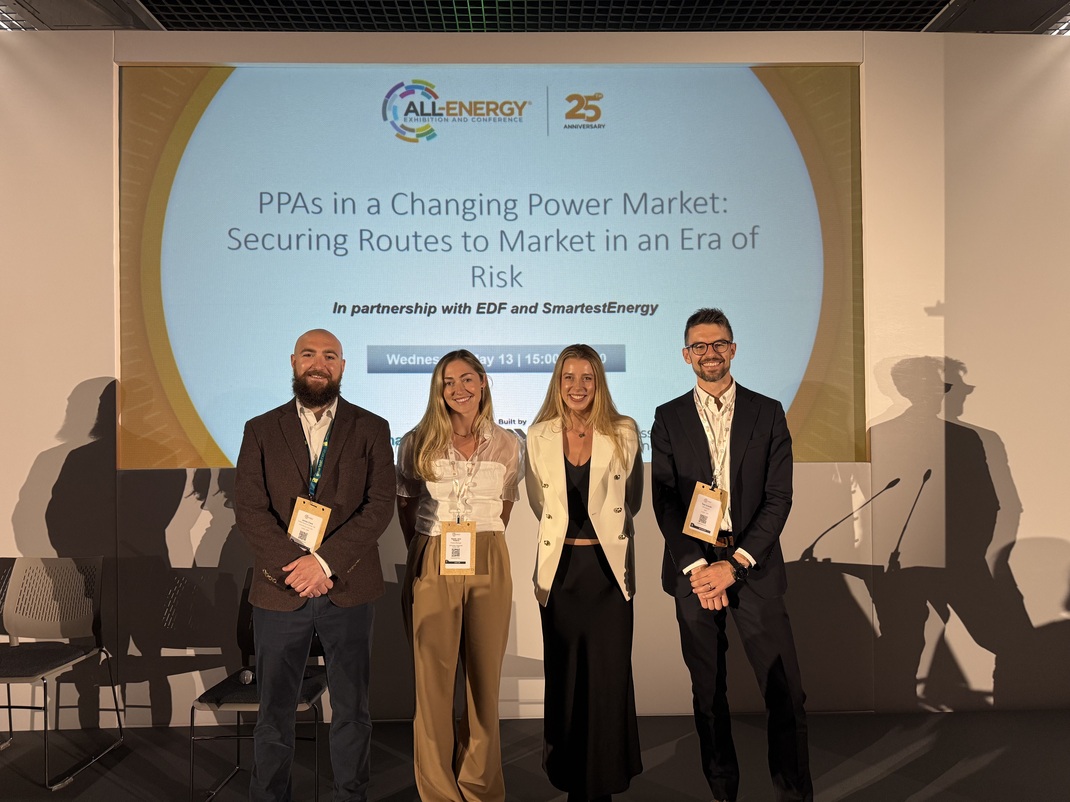
The PPA market is becoming more complex, more volatile, and more central to project financing than ever before. I had the pleasure of discussing this at a panel session at the All-Energy Exhibition and Conference: ‘PPAs in a changing power market: Routes to market in an era of risk’.
It was a great chance to share perspectives with developers, generators, offtakers and suppliers, and to talk through current market dynamics, the evolving risk landscape, and what’s needed to support bankability and investor confidence in PPA-backed projects.
A market evolving at pace
At ~68GW in size, the PPA market in Great Britain has been fundamental to the development of renewable generation capacity, and looking ahead PPAs will continue to play a critical role as electricity demand and the need for greater energy security increases.
As the renewables sector has scaled, the PPA market has evolved alongside it. We have seen a shift from shorter-term, flexible agreements towards longer-term, more structured and bankable contracts to ensure certainty and security. And we have also seen more of a shift from smaller generators to large-scale assets and portfolios, with investors taking a more active role.
Rising volatility and a shifting risk landscape
This progress, however, sits against a backdrop of heightened volatility. Geopolitical pressures, policy uncertainty and deeper renewable penetration have all contributed to increased risk.
Challenges such as price volatility, cannibalisation and curtailment, greater contractual complexity, and rising scrutiny from investors and lenders are all front of mind, driving a stronger focus on revenue optimisation, pricing strategies and risk management. Generators are increasingly exploring how flexibility can support more resilient revenue models.
We discussed how battery storage will play an important role in mitigating some of this volatility by helping to balance supply and demand and soak up market volatility, but deployment remains a race between the growth of renewable generation and the pace of storage capacity coming online.
The changing role of PPAs
As Sarah Pollard from Schroders Greencoat highlighted during the panel, “the revenue stack is changing”. A decade ago, projects were largely supported by subsidy schemes such as the ROC, but as these fall away and market dynamics continue to shift, PPAs have become increasingly important in maintaining revenues.
This shift is also changing what generators and investors need from a PPA. Key considerations discussed during the session included:
Different approaches: new build vs operational assets
It was also interesting to talk about how the role of PPAs is diverging depending on the stage of the asset.
New build projects – focus on bankability and risk reduction:
- Contracts for Difference (CfDs) remain the preferred route, supported by new 20-year tenors and reliable government backing. These are typically paired with long-term PPAs (CfD PPAs) to strengthen revenue stability
- Corporate PPAs (CPPAs) offer an alternative route, but activity has slowed due to higher pricing. A key challenge remains the gap between corporate willingness to pay and developer expectations
Operational portfolios – focus on diversification and optimisation:
- PPAs are increasingly used as a diversification tool, with generators adopting a mix of strategies across sites
- This includes flexible PPAs that enable multi-transaction sales, alongside structured products such as Framework PPAs, which combine index-linked pricing with opportunities to fix prices at key points
- Flexibility and diversity help optimise revenues in a more volatile market
What would improve investor confidence?
To close the session, Kristina Rabecaite from PPAYA, asked each of the panellists ‘Looking forward, what single change - regulatory, contractual, or market-driven - would most improve investment confidence in PPA-backed projects?’ Several clear themes emerged:
Looking ahead
What came through clearly from the discussion is that while the PPA market is becoming more complex, it is also maturing. As subsidy support continues to fall away, PPAs are no longer just a route to market, they are central to how projects are financed, managed and optimised over the long term.
Unlocking the next phase of growth will depend on navigating volatility, aligning expectations across the value chain, and delivering greater policy stability. As the market evolves, we’re seeing increasing demand for more flexible, tailored PPA structures that reflect real-world challenges.
At SmartestEnergy, we’re already supporting this shift, working closely with generators and corporates to structure agreements that balance risk, optimise revenues, and unlock long-term value. From CfD-backed routes, such as our recent deal with Bute Energy, to more flexible and, structured PPA solutions like our hybrid PPA with CWP, our focus is on helping projects to move forward with confidence in an changing market.
Discover our new ‘Navigating the UK PPA Landscape’ guide
Explore the key trends shaping the UK PPA market, from shifting risk strategies to the barriers impacting investment. With rising volatility, bankability pressures, and a widening pricing gap, this guide offers practical insight to help navigate an increasingly complex route to market.